
Liquid Pool Chemical Feeders: What Pool Pros Need to Know By Lauren Broom
Liquid chemical feeders can simplify pool maintenance for pool pros — but an awareness of their operation and maintenance is crucial for their effective use to maintain proper levels in a pool. Liquid pool chemical feeders are installed on commercial public pool equipment installations.
Sodium hypochlorite, also known as liquid chlorine or bleach, is the most often used liquid pool chemical that is pumped out of large vats with peristaltic chemical pumps. It is injected directly into the return line. Other chemicals like muriatic acid, soda ash or sodium bicarbonate (bicarb) mixture can also be pumped directly into a return line (using a different liquid chemical pump), to adjust pH and alkalinity levels.
How do they work?
A pool pro’s understanding of liquid feeder applications begins with a grasp of how they operate. Many of today’s liquid solution feeders fall into the category of positive displacement pumps, which means they rely on mechanically applied pressure, rather than suction, to push liquid chemicals solutions through their lines. Positive displacement liquid solution feeders include peristaltic pumps. Stenner, Rola-Chem and Blue-White are some of the main manufacturers of liquid chemical feed pumps.
Peristaltic pumps move chemicals through a flexible feed tube, squeezing the tube with a rotating set of rollers and produce an output-side pressure that usually falls between 25 and 100 psi. The mechanical simplicity of these pumps offers several advantages. These feeders are completely self-priming. The feeders also work quite well with gassing liquids like sodium hypochlorite due to their design being capable of pumping any gas along with the liquid right through the tube and in into the pool return line.
Throughout the past several years, automation systems have become more advanced, and chemical feeders have grown less expensive. This has allowed a much wider variety of customers to incorporate chemical feeders into their pool building projects. Today, some builders urge all their commercial public pool customers to incorporate automation along with liquid chemical feeders into their pool equipment installations. For example, in Florida, a
Chlorine & pH Stenner Liquid Peristaltic Pumps with chlorine and acid pH chemical storage tanks.
Lauren Broom is a Certified Pool Operator Course, CPO
, instructor and a former health inspector for the Florida Department of Health. Lauren has a Bachelor of Science Degree in Biology and is a registered sanitarian.
She has 16-years of experience in commercial pool inspections and waterborne disease outbreak investigations.
Lauren lives in Palm Bay, Florida with her husband and their 3 children.
Lauren can be reached at spacecoastpoolschool@yahoo.com
Lauren Broom majority of commercial public pools being built incorporate a Stenner liquid chemical disinfection feeder along with another Stenner liquid pH adjustment feeder.
One tidbit of advice here: Always properly size your chemical storage tank to hold at least 50-percent capacity of the maximum output rate of the liquid chemical feeder. This piece of advice is based on my experience as a pool inspector finding that chemical storage tanks would run out prior to the next visit by the pool pro for service.
A properly sized chemical storage tank will help lessen this issue and reduce the likelihood that the public pool will be closed. Also, make sure that the chemical storage tank when stored outdoors is completely sealed so that rainwater and other environmental matter cannot get into the tank. This can create a chemical safety issue and also cause chemicals to become diluted.
Pro-Active vs. Reactive Maintenance
I recently attended a free training course with Stenner at the Everything Under the Sun Expo in Orlando, Florida on March 14-15, 2025. The free in-person course covered basic preventative maintenance of their peristaltic pump.
Though liquid chemical feeders can do their work without daily input from the user, they are still subject to their share of potential issues. Frequent system checkups and adjustments and part replacements should be completed as necessary per the manufacturer.
This will help in keeping these devices efficient and trouble-free.
For a peristaltic pump, the most common issue is wear and tear on the feed tubes. This is simply due to the fact that the pump works by squeezing plastic tubes. Another potential problem is clogging in the lines.
Clogs can create back pressure that may damage the pump, so it is important to investigate this possibility on a regular basis. Thus, most experts recommend thoroughly checking the tubes of peristaltic pumps for leaks and clogs at least once per week.
Common Preventative (Pro-active) Maintenance
• Clean storage tanks to remove sediment buildup.
• Keep the weighted suction line strainer about three inches from the bottom of the tank.
• Inspect the injection point in the return line pipe to make sure it is clear so that the chemical solution can flow freely. Clean it out as needed.
• Schedule tube replacement at regular intervals.
• Look at the roller assembly each time you replace a tube to confirm the rollers are turning freely. Check to make sure that there are no visible signs of wear and tear on the rollers.
Many customers hope that automated liquid chemical feeders will bring an end to the days of constant maintenance, the fact is that any pool is a constantly changing system and requires regular checkups and adjustments to stay safe and efficient.
With that in mind, an understanding of liquid chemical feeder operations and maintenance will make it easier for pool pros to anticipate issues, fix them before they become real problems, and keep the entire system running smoothly.
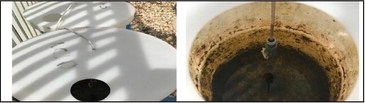
Outdoor muriatic acid chemical storage tank with hole in the lid. Liquid chemical feeder tube not in solution with live frog at the end on the weight.
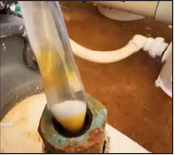
Clogged tube into return line from liquid chlorine feeder