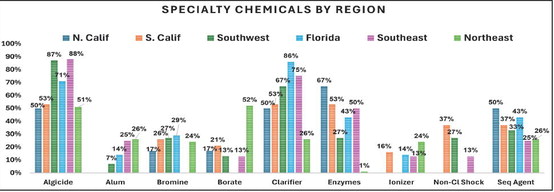

Responses to our chemical and equipment survey came in from 19 states. As we have come to expect, responses were heaviest from the areas with the highest number of pools. The top states in order of participation were California, Texas, Arizona, and Florida.
For statistical purposes, we divided the country into seven geographic regions, based on their location and the number of responses we received.
The following is the way we broke it down: Northern California — From the Oregon Border south to Bakersfield. Northern California represents 9 percent of the responses we received. We also included Oregon in this region.
Southern California — From the Mexican Border north to Bakersfield. Southern California represents 28 percent of the responses we received.
Southwest — Arizona; Colorado; Nevada; New Mexico; Oklahoma; Texas; and Utah. The Southwest represents 23 percent of the responses we received this year.
Florida —The Service Industry is large enough in this state for it to qualify as a separate region. Florida represents 11 percent of the responses received.
Southeast — Alabama; Arkansas; Georgia; Kentucky; Louisiana; Maryland; Mississippi; North Carolina; South Carolina; Tennessee; Virginia; and West Virginia. The Southeast represents 12 percent of the responses we received this year.
Northeast — Connecticut; Delaware; Maine; Massachusetts; New Hampshire; New Jersey; New York; Pennsylvania; Rhode Island; and Vermont. The Northeast represents 6 percent of the total number of responses that we received Midwest — Illinois; Indiana; Iowa; Kansas; Michigan; Minnesota; Missouri; Montana; Nebraska; North Dakota; Ohio; South Dakota; Wisconsin; and Wyoming. Because the Midwest represents 11 percent of the responses we received this year the data obtained was insufficient to include in this issue.
The average is actually the median Whenever possible, we use the median figure for determining averages. So the “average” price for the various levels of service represents actual prices that someone is charging. Half of the reported pricing is higher than the median, and half is lower.
When responses from a region were considered insufficient to give us an accurate reading, we dropped that region from our pricing survey. And whenever possible, we provide “highs” and “lows” for each level of service, to give you an idea of the ranges of pricing that we were dealing with. When considering dollar amounts, we rounded up or
this year. down to the nearest whole dollar.
To make it easier to evaluate business practices, all prices are organized by region.
Not all regions of the country respond to this survey section at the same level, but those that did will find these pricing guidelines useful in evaluating their business practices.
In general, the data that inspires the most confidence is based on higher participation and came from Southern California, and the Southwest.
The following is a regional breakdown for chemical prices as well as auto cleaners. We also include common testing methods, the use of salt water chlorine generators, and other specialty equipment.
Disclaimer Although it is not a purely scientific survey, we believe that our results present an accurate picture of the state of our industry in 2025.
When reader participation was deemed sufficient, we reported information on a variety of categories that were supported by adequate data.
Northern California includes the space from the Oregon Border south to Bakersfield. Northern California represents 9 percent of the responses we received for the survey.
For chlorine testing, respondents from Northern California indicated preference for DPD with 83 percent usage. ORP is in use by 33 percent of respondents, and both test strips and OTO are used by 17 percent, of those who responded.
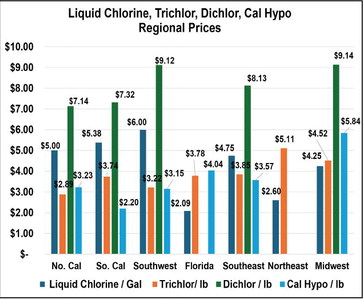
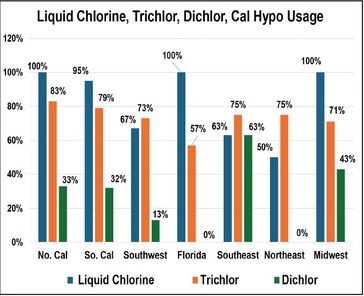
Service professionals from this region indicated a preference for liquid chlorine to sanitize pools, with 100 percent of regular technician usage. They get liquid chlorine at $5 per gallon on average.
For trichlor, used by 83 percent of respondents, Northern California professionals responding to the survey are paying $130 for a 50-pound bucket, which works out to $2.89 per pound of available chlorine for trichlor. Trichlor costs less than liquid on a per pound basis.
Calcium hypochlorite is used by 33 percent of those responding to the survey, and they pay an average of $3.23 per pound of available chlorine.
Dichlor, used by 33 percent of respondents, purchased in 50-pound increments costs an average of between $7.14 and $6.45 per pound of available chlorine, depending on whether it is anhydrous.
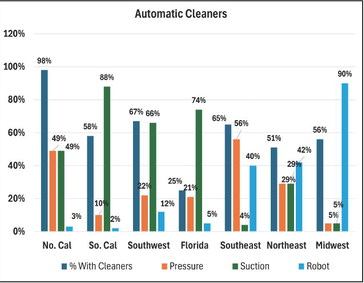
Service technicians from Northern California reported that on average of 98 percent of all their pools are equipped with an automatic pool cleaner. The cleaners are equally pressure side as suction side – 49 percent each, and only 3 percent are robots.
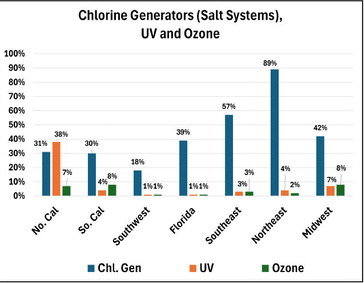
Salt water chlorine generators are encountered on an average of 31 percent of pools for sanitation.
Respondents indicated that about
Information contained in this survey is for informational and historical purposes only and is not meant to encourage readers to set prices in restraint of trade or in violation of any laws.
Northern California
38 percent of their pools utilize UV and 7 percent of their pools incorporate ozone.
Southern California
Southern California includes the region from the Mexican Border north to Bakersfield. This region represented 28 percent of the responses we received in this year’s survey.
As is the case for most years, responses from Southern California were heaviest so the data for this region is the most reliable.
For testing methods, responses to the survey indicate that Southern California services techs rely most heavily on test strips: 58 percent use. 32 percent reported also reported using DPD, and 21 percent report to using both OTO and ORP.
Liquid chlorine is used predominantly over other chlorine sources, with 95 percent usage. Trichlor is used at a high rate as well, with 79 percent usage. Dichlor is used by 32 percent, and calcium hypochlorite is used by 21 percent of those who responded to the survey.
Southern California service technicians pay a median price of $5.38 for liquid chlorine.
A 50-pound bucket of trichlor is priced at an average $170, which works out to $3.74 per pound of available chlorine – lower than liquid.
For dichlor, Southern California service professionals are paying an average of between $7.32 and $6.61 per pound of available chlorine, depending on whether it is anhydrous. Calcium hypochlorite prices are a median reported price of $2.20 per pound of available chlorine Service pros responding to our survey indicated the average of 58 percent of their pools have automatic pool cleaners.
As in years past, a large number of them, 88 percent are suction side cleaners as opposed to only 10 percent employing pressure side cleaners. Robotic cleaners are used Southwest
The Southwest represented 23 percent of the responses we received in this year’s survey.
Responses to the survey were particularly heavy from Arizona and Texas, and are thus much more representative of the maintenance preferences of those states in particular.
For disinfectant testing methods, service technicians responding to the survey reported heaviest use of DPD, employed by 60 percent of respondents. About 40 percent of respondents also use test strips, 20 percent use OTO, and less than 1 percent use ORP to assess chlorination levels.
Respondents from this region indicated greatest reliance on calcium hypochlorite as a chlorination method:
in 2 percent of the pools of those who responded.
Southern California service professionals reported that an average of 30 percent of their pools have salt water chlorine generators.
Respondents indicated that about 4 percent of their pools utilize UV and 8 percent of their pools incorporate ozone. 87 percent use calcium. This area pays an average price of about $205 for 100 pounds, or $3.15 per pound available chlorine. Liquid chlorine is used by 67 percent where the cost of liquid chlorine was reported to be $6 per gallon.
Trichlor is also widely used by 73 percent of those responding to the survey, where they pay a median price of $3.22 per pound of available chlorine. About 13 percent of respondents use dichlor, paying a median price of between $9.12 and $8.47 per pound of available chlorine, depending on whether or not the dichlor is anhydrous.
Respondents indicated that about 67 percent of their pools employ an automatic cleaner. More service professionals reported seeing suction side cleaners over pressure side cleaners, used in 66 percent and 22 percent of pools respectively, with 12 percent of pools using robotic cleaners.
Chlorine generators are employed on an average of 18 percent of the pools serviced by those responding to our survey.
Respondents indicated that about 1 percent of their pools utilize UV and ozone.
Florida
The Service Industry within Florida is large enough for it to qualify as a separate region. Florida represents 11 percent of the responses received.
Floridians have typically reported a high use of liquid chlorine in years past, with 100 percent of service professionals reported relying on liquid chlorine. Here, the price of chlorine has gone up, but compared to the rest of the country, they still get a great deal on the chemical at an average price of $2.09 a gallon.
With the higher price of trichlor, its use is less common, employed by 57 percent of respondents, averaging $171 for 50 pounds, or $3.78 per pound of available chlorine.
Calcium hypochlorite is used by 57 percent of respondents, who pay an average of about $263 for 100 pounds, or $4.04 per pound of available chlorine Responses from Florida concerning usage and pricing for dichlor were insufficient to report meaningful data.
Responses to our survey indicate that service professionals in Florida primarily use DPD as their means of accessing chlorine concentrations: 100 percent of respondents use this method. Test strips were used by 29 percent of respondents.
Respondents indicated that about 25 percent of their pools employ an automatic cleaner. More service professionals reported seeing suction side cleaners over pressure side cleaners, used in 74 percent and 21 percent of pools respectively, with 5 percent of pools using robotic cleaners.
Salt water chlorine generators sanitize 39 percent of the pools serviced by respondents, while less than 1 percent of respondent’s pools utilize either UV or ozone.
Southeast
The Southeast represented 12 percent of the responses we received in this year’s survey. Respondents from this region indicated a slight preference for calcium hypochlorite as a chlorination method: 88 percent use it.
This area pays an average price of about $232 for 100 pounds, or $3.57 per pound available chlorine. Liquid chlorine is used by 63 percent where the cost of liquid chlorine was reported to be $4.75 per gallon.
Trichlor is used by 75 percent of those responding to the survey, where they pay a median price of $175 for a 50-pound bucket, or $3.85 per pound of available chlorine.
About 63 percent of respondents also use dichlor, paying a median price of between $8.13 and $7.34 per pound of available chlorine, depending on if it is anhydrous.
Respondents from this region seem to favor the DPD method for testing chlorine: 75 percent of this area reported using DPD, while 13 percent also uses test strips, ORP, and OTO.
Respondents from this region indicated that an average of 65 percent of the pools they service incorporate an automatic pool cleaner. Suction side cleaners make up about 4 percent of these, pressure side 56 percent, and robots, 40 percent.
Service professionals in the Southeast report that salt water chlorine generators are on an average of 57 percent of the pools that they service.
Respondents indicated that about 3 percent of their pools utilize UV or ozone.
Northeast
The Northeast represents 6 percent of the total number of responses that we received in this year’s survey.
About 75 percent of those responding to the survey reported that they use trichlor to sanitize the pools they service, while liquid chlorine is used by 50 percent.
Respondents from the Northeast declare an average liquid chlorine cost of $2.60 per gallon, and $230 for a 50-pound bucket of trichlor tabs. For trichlor, this works out to $5.11 per pound of available chlorine.
Responses concerning calcium hypochlorite and dichlor were insufficient to report meaningful data.
For testing purposes, professionals reported reliance on test strips, both employed by about 75 percent. About 25 percent are using DPD and ORP. None of the respondents from this region reported to using the OTO testing method.
According to our survey, salt water chlorine generators are in use on an average of 89 percent of the pools serviced.
About 4 percent of pools incorporate ozone, while 2 percent use UV.
Service technicians reported that 51 percent of the pools they service are equipped with an automatic pool cleaner. Of those that use automatic cleaner, pressure side and suction side cleaners are split nearly equally at 29 percent usage each. Robotic pool cleaners make up 42 percent.
Midwest
The Midwest represents 11 percent of the responses we received.
For testing methods, responses to the survey indicate that Midwest services techs rely most heavily on DPD: 71 percent use. 14 percent reported also reported using other testing methods, including test strips, OTO and ORP. Liquid chlorine is used predominantly over other chlorine sources, with 100 percent usage. Trichlor is used at a high rate as well, with 71 percent usage. Dichlor is used by 43 percent, and calcium hypochlorite is used by 57 percent of those who responded to the survey.
Midwest service technicians pay a median price of $4.25 for liquid chlorine.
A 50-pound bucket of trichlor is priced at an average $204, which works out to $4.52 per pound of available chlorine – higher than liquid.
For dichlor, Midwest service professionals are paying an average of between $9.14 and $8.25 per pound of available chlorine, depending on whether it is anhydrous.
Calcium hypochlorite prices are a median reported price of $5.84 per pound of available chlorine.
Service pros responding to our survey indicated the average of 56 percent of their pools have automatic pool cleaners. A large number of them, 90 percent are robotic cleaners, with the balance split between pressure side and suction side cleaners.
Midwest service professionals reported that an average of 42 percent of their pools have salt water chlorine generators.
Respondents indicated that about 7 percent of their pools utilize UV and 8 percent of their pools incorporate ozone.