
Most service professionals know that balancing water chemistry is essential in closing a pool for the winter.
But one detail often overlooked is how temperature affects the Langelier Saturation Index (LSI) — and what that means for water balance during the off-season.
What is the LSI?
The LSI is a calculation that predicts whether water will be corrosive (aggressive) or scaleforming.
It factors in pH, alkalinity, calcium hardness, total dissolved solids, and temperature.
The goal is to keep the LSI close to neutral (between -0.3 and +0.3) so that water neither dissolves plaster and metals nor deposits scale on surfaces and equipment.
How does temperature shift the balance?
Temperature has a strong influence on the LSI. Although it may seem counterintuitive, warm water can hold less calcium carbonate in solution, so the risk is scale. Cold water, on the other hand, can hold more calcium carbonate in solution, which pushes the LSI downward toward the corrosive side.
That means when water temperatures drop in the late fall and into winter, the exact same pool chemistry that was balanced in summer may suddenly read as aggressive on the index.
Why does this matter during closing?
If a pool is closed with chemistry that looks “normal” for summertime, it may not be balanced once water temperatures drop into the 40s or 50s. Low-LSI water through the offseason can:
• Etch plaster surfaces — Aggressive water dissolves calcium, leaving rough or pitted finishes.
• Corrode metals — Rails, ladders, and heat exchangers are especially at risk.
• Weaken grout or tile beds — Long-term exposure to aggressive water compromises integrity.
Nowadays, online LSI calculators abound that will simplify the process of calculating the LSI.
(Note: If you are using an LSI calculator, be sure to use one that accounts for CYA and Borates.)
But for those who wish to see what’s behind the curtain, the simple LSI formula is as follows:
How do I calculate theLSI? LSI = pH + F(T)+ F (TA) + F(CH) – F(TDS)
In this formula, Temperature, Total Alkalinity, Calcium Hardness, and Total Dissolved Solids each have specific factors assigned, as detailed in Table 1, Water Balance Factors for Use in LSI Calculations. The pH value is used as it is directly measured from the pool, without an additional factor.
Note: Whether you use an online calculator or prefer to do the math yourself, it’s important to factor in the effects of cyanuric acid and borates, if used, because both have an effect on the total alkalinity.
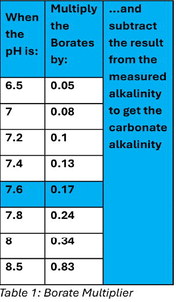
Both cyanuric acid and borates contribute to the measured total alkalinity. However, it is only the total carbonate alkalinity we are interested in, so contributions from cyanuric acid and borates must be subtracted out. Unfortunately, we cannot simply subtract the numbers measured in the cyanuric acid and borate tests. Rather, we must subtract out a factor, based on the amount each contributes, each of which is influenced by the pH at the time they are measured.
For Cyanuric Acid, apply the following equation, using the appropriate correction factor from Table 1: CYA Multiplier.
Carbonate Alkalinity = Total Alkalinity – (Measured Cyanuric Acid × CYA Multiplier) Thus, at pH 7.6, if the test for total alkalinity shows 80 ppm, while the test for cyanuric acid shows 100, the carbonate alkalinity is roughly 47.
80 – (100 × 0.33) = 47 For borates, which also have a pH dependent effect on the total alkalinity, apply the following equation, using the appropriate correction factor from Table 1: Borate Multiplier.
Carbonate Alkalinity = Total Alkalinity – (Borates x Borate Multiplier) Thus, at pH 7.6, if the test for total alkalinity shows 100 ppm, while the borate test shows 50, the carbonate alkalinity is about 92.
100 – (50 x 0.17) = 91.5.
Adjust for Temperature
The solution is to compensate for colder water when closing. That often means slightly increasing calcium hardness, raising alkalinity, or adjusting pH upward before shutting down the pool. Service pros should calculate the LSI with the expected winter water temperature (not just the current one) to ensure the water stays in balance all season long.
A Practical Example A pool balanced at 76°F with pH 7.5, alkalinity 90 ppm, and calcium hardness 250 ppm may show a perfect LSI that is near zero. But when that same water cools to 46°F, the LSI could drop into the corrosive range. Adding between 50–75 ppm calcium hardness before closing could stabilize the water and protect surfaces during the winter.
Here’s an example showing how colder water pushes the LSI down, plus two simple adjustment paths to keep winter water in range. (Assumptions: TDS = 500 ppm, values as CaCO3.). For the following calculations, See Table 1 Water Balance Factors.
Example 1: Same water, two temperatures Summer balance: pH 7.5, TA 90 ppm, CH 250 ppm, TDS 500 ppm At 76°F LSI=pH + F(T) + F(TA) + F(CH) − F(TDS) LSI = 7.5 + 0.6 + 2 + 2 – 12.1 = 0 → Water is Balanced At 46°F LSI=pH + F(T) + F(TA) + F(CH) − F(TDS) LSI = 7.5 + 0.2 + 2 + 2 – 12.1 = – 0.4 → Water is Slightly Corrosive. Risk of etching all winter.
Takeaway: The only change is temperature, but LSI drops by -0.4 just from cooling.
If you close on summer numbers, winter water can become aggressive.
How to Adjust to keep LSI ≈ 0 at 46°F Option A (raise CH & TA a bit, small pH lift): pH 7.7, TA 125 ppm, CH 325 ppm → LSI ≈ 0 (neutral) LSI = pH + F(T) + F(TA) + F(CH) − F(TDS) LSI = 7.7 + 0.2 + 2.1 + 2.1 – 12.1 = 0 → Water is Balanced Option B (modest CH bump, slightly higher pH, keep TA): pH 7.8, TA 90 ppm, CH 300 ppm → LSI ≈ 0 (neutral) LSI = pH + F(T) + F(TA) + F(CH) − F(TDS) LSI = 7.8 + 0.2 + 2 + 2.1 – 12.1 = 0 → Water is Balanced Both keep winter LSI inside the typical target band (about –0.3 to +0.3) Quick how-to for closings
1. Estimate winter water temp (often 45–55°F).
2. Run LSI with that temp, not the current fall temp.
3. Nudge pH/TA/CH so LSI at winter temp is near zero. Commonly: a small pH lift (0.1–0.3), +10–30 ppm TA, and +50–100 ppm CH.
4. Recheck before you add winter chems and cover.