
Assuming that the informationgathering steps confirmed that there is indeed a leak and provided an idea of where that leak might be, the Isolation Step exists to confirm these suspicions.
Objective
The objectives of isolating the leak are to reduce the search area and to guarantee non-leaking areas.
Method: Pressure Test
Performing a pressure test on every job regardless of the suspected leak location is the only way both objectives can be accomplished with any certainty. A pressure test is valuable not only if a plumbing leak is suspected but also if the pool shell is suspected. By eliminating the entire plumbing system as a potential leak area, our pool shell suspicion becomes a certainty.
With proper equipment and an understanding of the pressure testing principles, pressure tests can be done in minutes and give results that assure 100-percent confidence.
Pressure testing checks the integrity of the plumbing. Exposed openings of a plumbing line are blocked off, and the line is put under measurable pressure. A pressure drop indicates a leak. A line that holds can be eliminated as a potential leak location.
Pressure Testing Safety Rules
• Turn off all equipment before testing.
• Use straight-sided test plugs.
• Do not over-expand a plug to fit a larger hole.
• Never exceed 20 psi pressure (5 psi maximum on openings greater than 2 inches).
• Stand clear of plugged openings.
• Release pressure after test is complete.
• Never use an unregulated air source.
• Use well-maintained equipment. Pressure Testing Equipment For accurate pressure testing, the following equipment will be needed:
• Assorted Tests Plugs — to block the openings of the pipe to be tested.
• Pressure Tester — that allows the introduction and measurement of water pressure.
• Garden Hose — to hook to a water source that provides at least 20 psi of pressure.
Utilizing quality equipment assures efficient and accurate tests.
Test Plugs
Test plugs must provide a solid seal that will not leak or allow the plug to pop out under pressure. Any plug used for pressure testing should have straight-sided — not tapered — rubber. Straight-sided rubber provides about 1 ½ inches of seal inside the pipe, which is safe to about 20 psi. A tapered, winterizing plug only provides about 1/8 inch of seal, which is safe to about 5 psi, not enough to hold the pressure required for a pressure test. A plug that pops out under pressure wastes valuable time and puts anyone in the area at risk for injury.
Test plugs are available in a wide selection of sizes and styles for plugging virtually any plumbing opening. It will be necessary to have an assortment of plugs that will seal common PVC pipe sizes as well as fittings, different kinds of pipe, and oddball situations. Choose plugs with corrosion resistant, heavy-duty hardware and large, easy-to-turn wingnuts.
Test plugs are the main tools used by a leak detector, so it’s important that they function when they are needed.
• Standard Plugs.
• Hook Plugs.
• Extender Plugs.
• Inflatable Plugs. Standard plugs are used for any cut ends of pipe, pump inlets, or other easily accessible fittings.
Hook plugs are used for main drains and return fittings (past threads). Hook plugs have a 1 ½-inch extension between the wingnut and the rubber. They allow a seal to be made further inside the pipe. They can be used on main drains and return fittings to get past the threads into the smooth part of the pipe.
Extender plugs are used in situations where a seal must be made even further inside the pipe. Common applications include skimmers, therapy heads, in-floor cleaners fittings, and return lines that enter the pool at an angle.
Inflatable plugs act like a balloon. They are blown up with an air compressor or pump to expand and seal inside the pipe or fitting. They cost more than mechanical plugs, and they’re not as durable, but in some cases, they’re the only thing that will work. They are used to seal out-of-round holes, hard to reach spots, main drains, special situations, and large pipes. When attached to an extension hose, inflatable plugs can be pushed some distance inside a pipe or even used to plug main drains from the pool deck. Inflatable plugs are available in large sizes so they can also be used to test larger pipes found on commercial pools.
Pressure Tester
A pressure tester allows the introduction of air or water into the plumbing system to be tested. Pressure testers come in a variety of shapes and sizes, but all must have several main components or characteristics.
Requirements:
• Versatile means of connecting to plumbing.
• Water and air connections.
• Control valve(s).
• Relief valve.
Versatile plumbing connections: The pressure tester must be able to access or put pressure into the plumbing system at a variety of different openings. Anderson’s pressure tester uses different sizes of open stem plugs, (plugs with a hole running through the center) to do this. This versatile system eliminates the need to cut pipe, jury-rig fittings, or depend on leaky threads. By quick connecting the appropriate open stem plug to the tester, pressure can be induced from the return lines or after the filter or heater on the return side. On the suction side, pressure can be induced through the pump or at the skimmer.
Water and Air Connections: The pressure tester must have connections for both water and air. Water is used for initial line testing; air is used for later leak pin-pointing. A regular garden hose connection works for the water side; a quick connect fitting is helpful for the air side.
Control Valve: Water and air pressure are turned on at the source (at the hose spigot at the house). A valve on the pressure tester is used to control the introduction of air or water through the open stem plug into the plumbing system. For a pressure test, water is let into the line to a pressure of 20 psi and the valve is closed.
Pressure Gauge: A drop in pressure indicated on the pressure gauge is a sign of a leak in the line. To be able to identify a small drop in pressure, a 0-30 pressure gauge should be used.
Relief Valve: Pressure is released from a system that does not have a leak with a pressure relief valve.
A good pressure testing kit combines an assortment of test plugs and pressure induction equipment that enables most swimming pool plumbing lines to be tested without cutting pipe, depending on leaky threads, or jury-rigging fittings.
As your needs grow, additional plugs and equipment can be added to the kit.
Anderson’s Pressure Testing Kit Includes:
– Pressure Tester. – Open Stem Plugs. – Closed plugs: assorted sizes and styles – Instructions. – Durable Tote with room for
Quick Pressure Testing for Structural Leak
If a structural leak is suspected, the entire plumbing system can be pressure tested to eliminate it as a potential leak location. The skimmer and return openings should be plugged or used as a pressure induction location. The pool equipment will be included in this pressure test.
Pressure Tests – Plumbing
If a plumbing leak is suspected, specific pressure tests will be used to isolate which section of the plumbing is leaking. If the pool is equipped with valves that control the flow to several different lines, these valves can be used to help with this isolation as long as they are tested first.
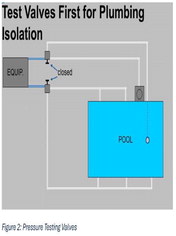
Test the Valves first for plumbing isolation: Close all valves and test from the equipment to the closed valves.
If the system holds pressure, then the valves can be used to isolate individual lines.
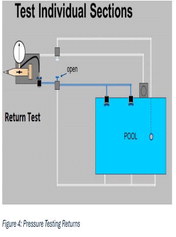
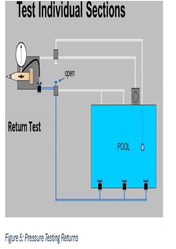
Then test individual plumbing lines to identify leaking section including:
• Skimmer line(s).
• Return line(s).
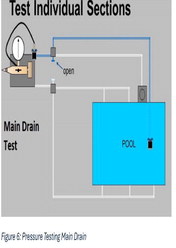
• Main Drain(s).
Main Drain:
The main drain is usually tested last because for a truly accurate pressure test, the main drain should be plugged.
However, a simple test can be done without the plug. Put air into the line until it bubbles out of the main drain. Then close the valve on the pressure tester. Assuming the main drain is under 9 feet of water, the water column above it should provide 5 psi of pressure on the trapped air. A pressure drop to below 5 psi is an indication of a leak someplace in the upper section of the plumbing.
A leak in the section under the pool shell will not be indicated.
additional tools.
Pressure Testing Kit