
Few topics in the pool and spa industry generate as much confusion — and quiet disagreement — as cyanuric acid (CYA). More than 70 years after its introduction, we are still refining how we think about it. What has changed is not the chemistry, but our understanding of how to manage it.
Cyanuric acid has been used since the 1950s to protect chlorine from ultraviolet degradation. Both hypochlorous acid (HOCl) and hypochlorite ion (OCl-) absorb UV light and are rapidly photolyzed in outdoor pools. In the absence of CYA, free chlorine is destroyed by this light, with levels dropping dramatically in just a few hours of strong sunlight.
Controlled outdoor studies have shown that several ppm of free chlorine can fall to near zero within a few hours without stabilizer, while a modest CYA level (for example, approximately 20-30 ppm) dramatically slows that loss.
The mechanism is straightforward. When chlorine is added to water containing cyanuric acid, it forms weakly-bonded chloro-isocyanurate species.
These complexes are far more resistant to UV photolysis than unbound HOCl. The bond is reversible and in rapid equilibrium, meaning chlorine is not permanently tied up — but most of it is temporarily associated with CYA at typical pool concentrations.
Free chlorine (FC) is not itself a single chemical species. Even without CYA, chlorine exists in pHdependent equilibrium: HOCl ⇌ H+ + OCl At pH 7.5, roughly half of the free chlorine is present as HOCl, the far more powerful oxidizer and disinfectant. The rest is OCl-, which is much less reactive.
When CYA is introduced, a second equilibrium dominates. The majority of measured free chlorine becomes reversibly bound to cyanurate, as dichlor (sodium dichlor, Sodium Dichloro-S-Triazinetrione) and trichlor (trichloro-s-triazinetrione).
Only a small fraction remains as active HOCl at any given moment. Numerous equilibrium models developed over the past several decades — and refined in the 2000s with improved thermodynamic constants — consistently show the same result: The concentration of hypochlorous acid is approximately proportional to the ratio of free chlorine to cyanuric acid.
In simplified form: HOCl ∝ FC / CYA In a pool containing cyanuric acid, the free chlorine alone does not ensure proper sanitation.
This relationship has been confirmed repeatedly in both theoretical modeling and experimental validation.
Modern speciation calculations show that increasing CYA while holding FC constant reduces HOCl concentration almost linearly over common operating ranges.
Disinfection kinetics depend on HOCl concentration. Reaction rates with bacteria, viruses, and algae scale with the amount of active hypochlorous acid present.
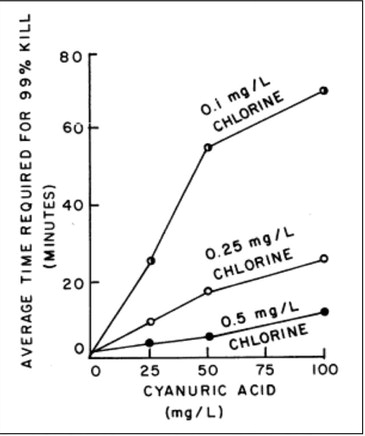
Classic microbiology work — including mid-20th century studies on organisms such as Streptococcus faecalis — demonstrated that increasing CYA while holding FC constant significantly lengthened kill times. The accompanying graphic shows cyanuric acid increasing on the x-axis. Each trace shows a different chlorine concentration. It can be seen that it takes longer to achieve 99 percent destruction of bacteria as the cyanuric acid concentration goes up.
More recent laboratory work has confirmed the same principle across a range of organisms: Higher CYA reduces instantaneous disinfection rates unless FC is increased proportionally.
However, an important nuance has emerged in modern guidance.
Figure 1: Chemical Structure of unchlorinated Cyanuric Acid.
While CYA slows instantaneous kill rates, there is no documented outbreak that has been directly attributed to a specific CYA level in a properly chlorinated pool maintaining required free chlorine residuals. This distinction matters.
That is because the issue is not that CYA “turns chlorine off.” It moderates chlorine activity. Whether that moderation becomes problematic depends on the FC/CYA ratio.
The Centers for Disease Control and Prevention (CDC) and the World Health Organization (WHO) continue to recommend maintaining appropriate free chlorine residuals in pools, with CYA typically limited in public aquatic venues. Many U.S. state codes restrict CYAin commercial pools (often ≤ 15 ppm or prohibit it entirely indoors) specifically to ensure rapid disinfection kinetics.
The WHO has long referenced oxidation-reduction potential (ORP) targets around 650 mV as indicative of effective disinfection. That ORP level corresponds roughly to a minimum HOCl concentration on the order of 0.01 ppm under typical pool conditions. Such levels are generally adequate for control of many bacteria and viruses.
Algae control, however, is a different matter.
Field experience and equilibrium modeling over the past 20 years have converged on a practical observation: preventing algae growth requires a higher HOCl concentration than what is needed to inactivate many bacteria.
Independent chemists and service professionals who modeled chlorine-CYA equilibria in detail demonstrated that maintaining free chlorine at approximately 7-8 percent of CYA provides a minimum HOCl concentration sufficient to prevent most algae growth under typical outdoor conditions. Higher ratios — on the order of 10-12 percent — provide a stronger safety margin.
Importantly, this aligns with equilibrium chemistry. If CYA rises, free chlorine must rise proportionally to maintain the same active HOCl concentration.
For example:
• 2 ppm FC with 20 ppm CYA.
• 4 ppm FC with 40 ppm CYA.
• 6 ppm FC with 60 ppm CYA. All produce similar HOCl concentrations at the same pH.
From a chemical standpoint, these scenarios are functionally equivalent.
And over the last 20 years, several things have become clearer: First, CYA does not meaningfully slow oxidation of ammonia and urea once equilibrium is accounted for — provided the FC/CYA ratio is maintained. Reaction rates follow HOCl concentration, not total FC. The ammonia doesn’t care about the 'Total Free Chlorine' (FC) reading on your kit; it only reacts with the tiny fraction that is HOCl. It is the concentration of HOCl that must remain constant for the reaction rates to remain constant.
If you increase your FC to match the increase in CYA (maintaining the ratio), the HOCl concentration stays constant. Conversely, the reaction rate will slow down if you increase the CYA without proportionally raising the total chlorine.
Second, cryptosporidium remains chlorine-resistant regardless of CYA. High CYA does not create this problem; it already exists. Cyanuric acid doesn’t cause chlorine to fail at killing crypto because chlorine was never good at killing crypto to begin with. Even with 0 ppm CYA (maximum 'strength' chlorine), the kill time for crypto is still measured in days, not minutes. Secondary systems (UV or ozone) may be the solution.
Figure 2. Chemical Structure of chlorinated Cyanuric Acid used for pools, Dichlor and Trichlor.
Third, ORP becomes less reliable at higher CYA levels. Because ORP responds primarily to HOCl concentration, pools with high CYA and proportionally higher FC may show lower-than-expected ORP readings even when adequately sanitized. At high CYA levels, the buffer effect is so strong that adding more chlorine doesn't change the HOCl concentration enough to move the ORP needle.
Finally, there is no additional UV protection benefit beyond moderate CYA levels. Photolysis protection increases rapidly up to roughly 2030 ppm and then shows diminishing returns. Once you pass 30-50 ppm, the 'protection curve' flattens out. That’s because nearly all the chlorine that can be protected is already bonded or shielded. While the protection benefit stops growing, the sanitation downside keeps getting worse. You are losing killing power without gaining any significant extra sun protection. The traditional industry recommendation of: FC: 2-4 ppm CYA: 30-50 ppm is a workable starting point — but it only works reliably if the ratio is respected.
If CYA drifts upward due to stabilized chlorine use (trichlor or dichlor), maintaining 2-4 ppm FC may no longer be sufficient to control algae or maintain comparable disinfection kinetics.
Conversely, operating at higher FC with proportionally higher CYA can be chemically sound, provided water balance and bather comfort are maintained.
The chemistry has not changed since the 1960s. What has changed is our appreciation of the dynamic equilibrium system:
• Free chlorine is not all active.
• HOCl drives reaction rates.
• HOCl concentration tracks with the FC/CYA ratio.
CYA is neither villain nor savior — it is a moderator.
In the end, it is still about the ratio. And if you remember nothing else about cyanuric acid and chlorine, remember this rule of thumb: To prevent most algae, maintain free chlorine at a minimum of 7.5 percent of the cyanuric acid concentration.
Figure 3: From Factors influencing the effectiveness of Swimming Pool Bactericides, G.P Fitzgerald and M.E. DerVartanian, Applied Microbiology, 1967.